Grants for Churches: How Faith Communities Get Funded
Congregations do some of the most practical work in their neighborhoods — feeding people, tutoring children, sheltering families, and holding communities together. Funders support that work. What stops most churches isn't worthiness; it's not knowing where the money comes from or what a funder expects to read.
This guide walks through the funding landscape, what it takes to be grant-ready, and the steps of a competitive application — in plain English, for ministries that are doing this alongside everything else.
Where the money comes from
Five funding sources open to faith-based organizations
Private and family foundations
The most common starting point for congregations. Many fund community programs — food, youth, housing, health — run by faith-based organizations, even when they don't fund worship itself.
Community foundations
Place-based funders that support local organizations in a specific city, county, or region. Their staff often meet with applicants before a deadline.
Corporate giving programs
Local employers, banks, hospitals, and utilities often fund neighborhood programs and sponsor events in the communities they serve.
Government funding
Federal, state, county, and city agencies fund services like food assistance, after-school programs, workforce training, and emergency shelter. Faith-based organizations may apply, but funds must support the service — not religious activity.
Denominational and judicatory funds
Many denominations, dioceses, conferences, and regional bodies offer their own grants for congregational ministry, building needs, and new programs.
Before you apply
Are you grant-ready?
Nearly every application asks for the same underlying pieces. Gather them once and you can apply again and again.
- A clear description of the program you want funded — who it serves, where, and how often.
- Legal and tax documentation (incorporation, EIN, and tax-exempt status or a fiscal sponsor).
- A program budget and an organizational budget that add up and agree with each other.
- Bank account and bookkeeping in the organization's name, with someone accountable for reporting.
- A board or governing body that meets, keeps minutes, and can approve applications.
- Basic records of who you serve and what happens as a result — even simple sign-in sheets count.
The process
Six steps from idea to submitted application
1. Define the program before you look for money
Funders fund programs, not general need. Write one paragraph naming the need, the people served, the activities, and the result you expect. Everything else grows from this.
2. Research funders who already fund work like yours
Look at community foundation grant lists, local funders' recent awards, and denominational programs. Read the eligibility rules and the geography limits first — most rejections happen here.
3. Make contact before you apply
Many funders welcome a short call or email describing your program and asking whether it fits. A five-minute conversation can save weeks of writing.
4. Write the narrative in the funder's order
Answer the questions asked, in the order asked, using their word limits. Describe the need with local evidence, then the activities, then who does the work, then how you'll know it worked.
5. Build the budget and gather attachments
Every dollar in the budget should be visible in the narrative. Collect required attachments early — letters of support and audited or reviewed financials are the usual bottlenecks.
6. Submit early, then steward the relationship
Submit ahead of the deadline, thank the funder either way, ask for reviewer feedback if you're declined, and report on time when you're funded. Reporting is how the next grant gets easier.
What holds applications back
Six mistakes that cost churches funding
- Asking for general operating help with no program
- Reframe the request around a specific service the congregation already provides.
- Applying outside the funder's guidelines
- Geography, organization type, and program area are hard limits, not preferences.
- Describing need without evidence
- Use local numbers, waiting lists, and firsthand observations from your own ministry.
- Blurring service and worship in a government application
- Public funds support the service delivered; keep religious activity separately funded and clearly distinct.
- Budgets that don't match the narrative
- Reviewers check. Line items with no explanation are the fastest way to lose points.
- Starting three days before the deadline
- Attachments and board approvals take longer than the writing does.
Work through it step by step
The workbook behind this guide
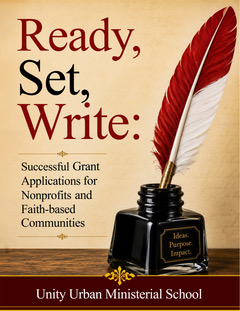
Ready, Set, Write: Successful Grant Applications for Nonprofits and Faith-based Communities takes every step above and turns it into exercises, checklists, and planning tools you can complete for your own ministry — funder research, narrative writing, document preparation, and proposal review.
Common questions
Church grant FAQs
- Can churches receive grants?
- Yes. Churches and faith-based organizations regularly receive grants from private foundations, community foundations, corporate giving programs, denominational funds, and — for community services rather than religious activity — government agencies.
- Do we need 501(c)(3) status to apply?
- Churches in the United States are generally treated as tax-exempt without filing for recognition, but many funders still ask for documentation. If a funder requires a determination letter you don't have, ask whether a fiscal sponsor is acceptable.
- Will a grant pay for our building or worship services?
- Rarely for worship itself. Capital and facility grants do exist, and funders often support a shared-use space when the community program that will use it is clearly described.
- How long does the process take?
- Plan on weeks to months. Foundation cycles commonly run one to six months from deadline to decision, and government competitions can take longer.
- Where should a small congregation start?
- Start locally: your community foundation, nearby corporate givers, and your own denomination. Smaller local awards build the track record that larger funders look for.